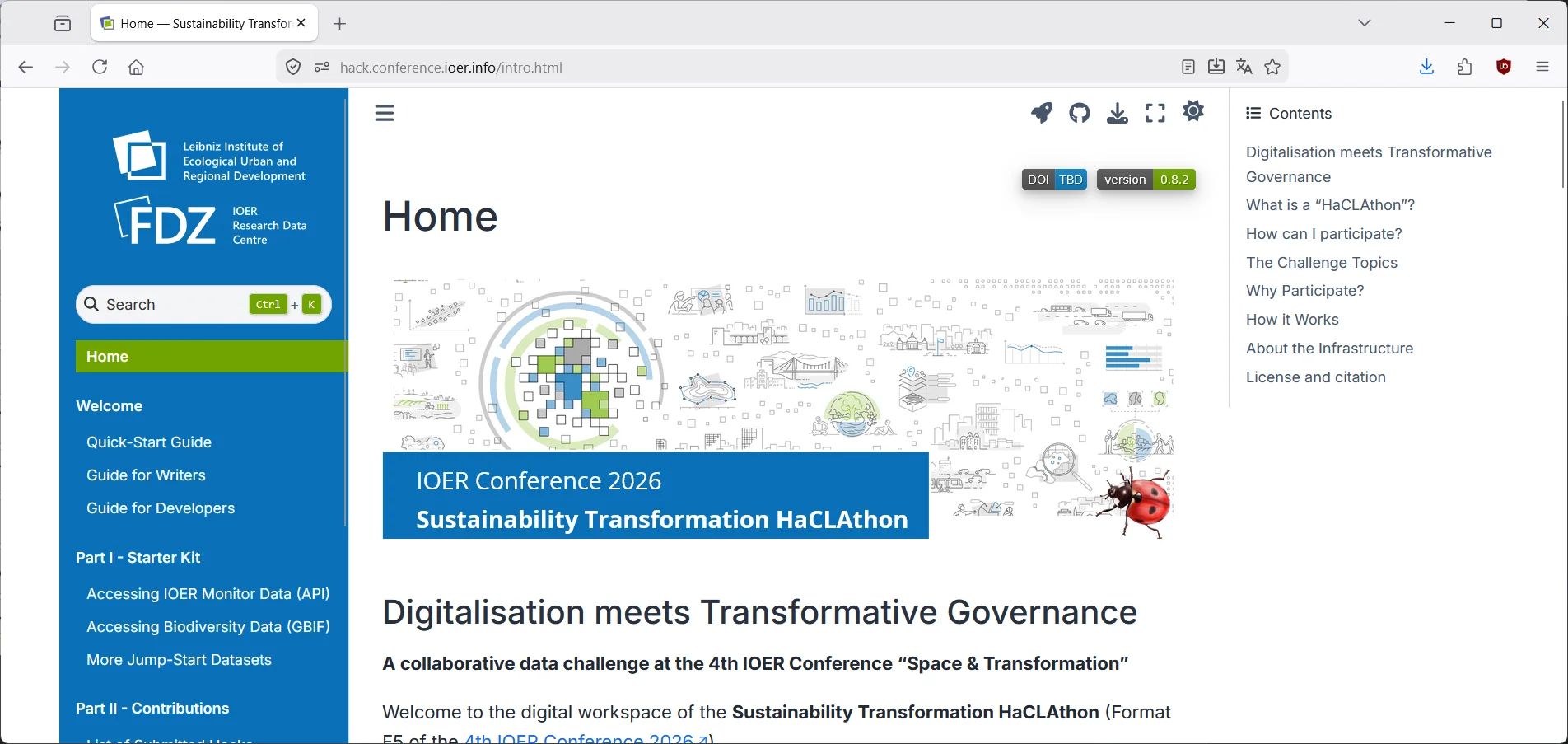
HaCLAthon & Rethinking Scientific Conference Collaboration
Traditional hackathons are often 24-hour marathons that produce impressive prototypes but rarely result in sustainable, citable scientific output. For the 4th IOER Conference “Space & Transformation” in 2026, we are testing a different approach, the HaCLAthon.
Collaborative, Long-term, Asynchronous
The acronym stands for our core philosophy. We want to move away from the “sprint” and toward a Collaborative, Long-term, and Asynchronous data challenge. Instead of a single weekend, this format runs over five months, allowing interdisciplinary teams to co-produce a living publication incrementally.
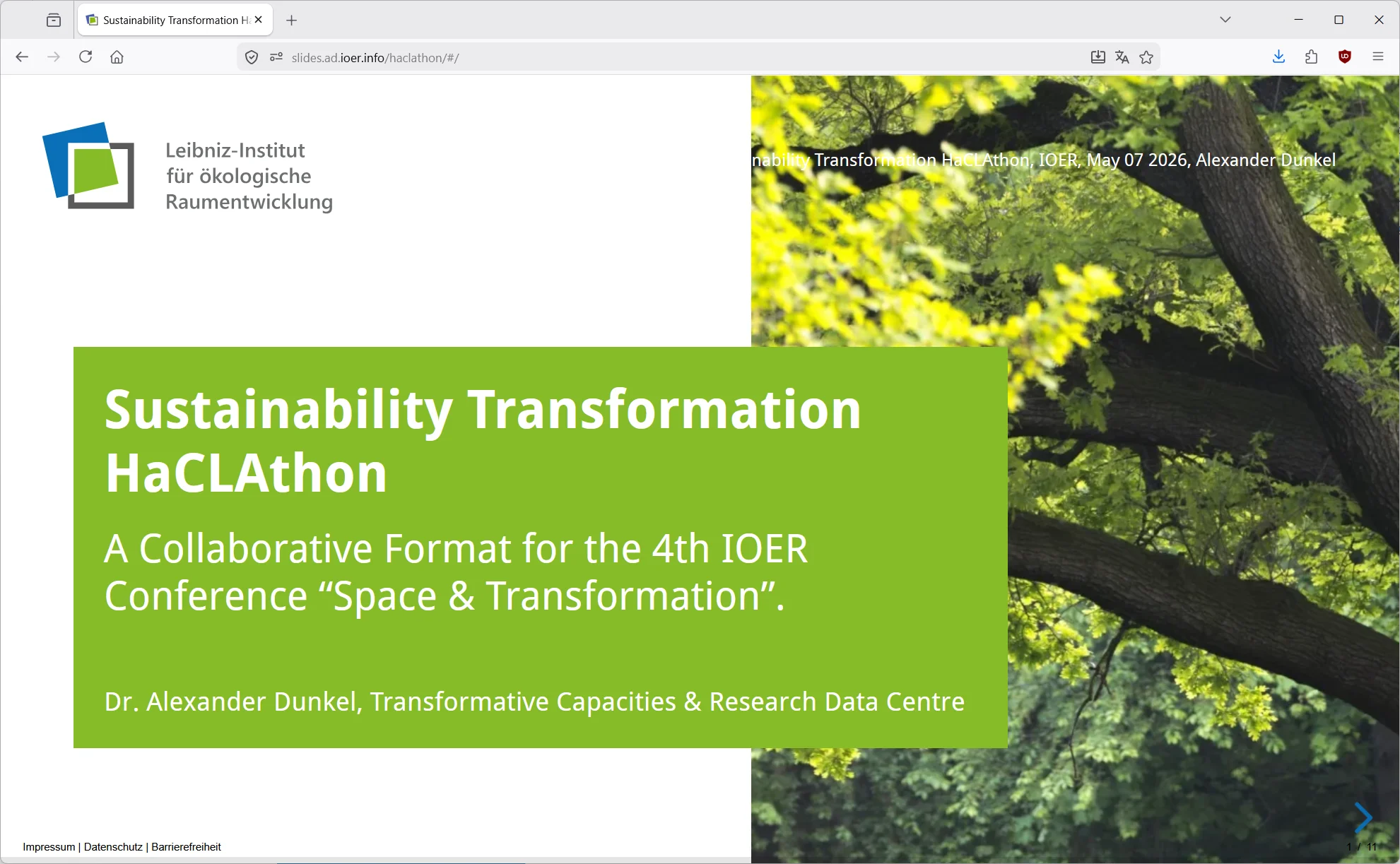
This was an internal presentation I just held to present the concept of the HaCLAthon to colleagues.
Infrastructure
As a Research Data Centre (FDZ), our challenge was to build a system that is technically rigorous enough for reproducible science, yet accessible enough for domain experts who don’t write code. We settled on a “Dual-Path” architecture:
- For Developers: A standard Git-based workflow. Participants fork the repository and work directly in Jupyter Notebooks, utilizing the Jupyter4NFDI cloud or our local Carto-Lab Docker environment to ensure 100% computational reproducibility.
- For Writers: A browser-based Workflow Editor (DecapCMS). This allows non-technical contributors to write data stories and conceptual chapters in Markdown without ever touching a terminal.
Secure and sovereign
Because scientific attribution and data privacy are paramount, we didn’t want to rely on third-party authentication black boxes. We implemented a self-hosted, Go-based OAuth broker to handle the GitHub handshake. This ensures that:
- Every edit is tied to a verified GitHub ID for the final DOI publication.
- The handshake happens on our institutional servers, keeping us DSGVO-compliant.
- Edits from the browser don’t go live instantly; they enter an editorial Kanban board as Pull Requests for our team to review.
Path forward
The goal of the HaCLAthon is to move beyond the static conference PDF. The final result will be a citable Jupyter Book, a digital artifact containing interactive maps, executable code, and collaborative narratives that represent the collective knowledge of the conference format.
If you are interested in the technical setup or want to participate, you can find the live book here: https://hack.conference.ioer.info/