CSS Workshop Dresden: Measuring Social Cohesion with Geo-Social Data
I gave a presentation at the internal workshop “Computational Social Science – Spatial Approaches and Perspectives”, organized by Diego Rybski (Urban Complexity group at the IOER) and Eckehard Olbrich (MPI-MIS Leipzig). The workshop brought together researchers working on complex systems, physics-based modeling, and network science.
My presentation was titled “Responsible Geo-Social Data for Measuring Social Cohesion”. With my formal habilitation lectures scheduled for mid-October at TU Dresden, I used this 30-minute slot as a trial run to test my narrative, argumentation, and slide structure.
From Landscape to Neighborhood Social Cohesion (NSC)
Based on the infrastructure ideas I presented at Data4Society in June, I adapted the framework toward mapping neighborhood social cohesion. I combined our privacy-preserving HyperLogLog (HLL) baseline pipeline with recent empirical work. This included Ridwan Wahed’s study on zero-shot LLM classification of Big Five personality traits across Germany, which we recently presented at EuroCarto 2026. I also integrated Jakob Napiontek’s work on synthetic population modeling (SynPop-DE) to illustrate how generative models can provide safe testing environments for spatial policy interventions.
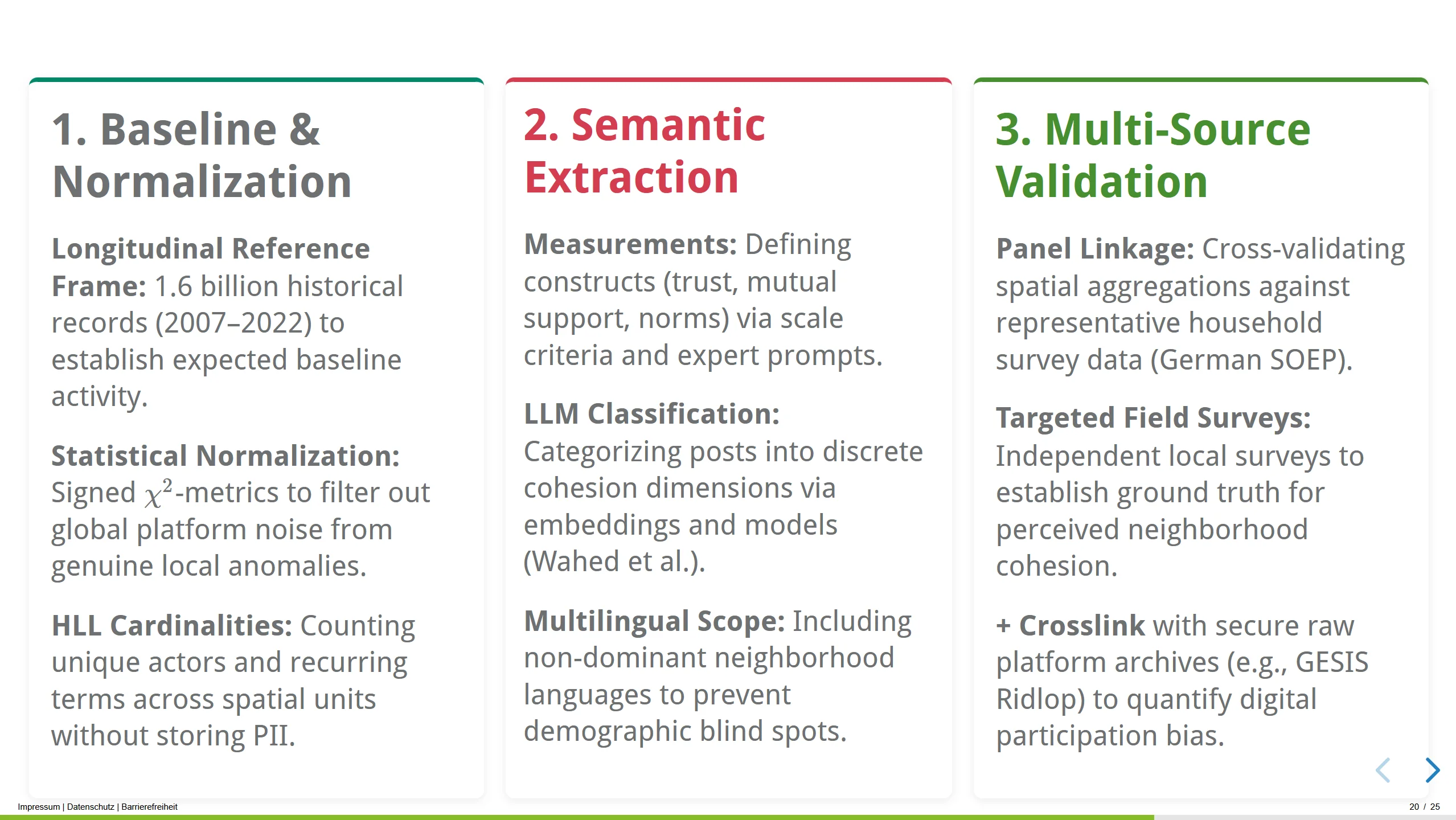
The core of the presentation focused on three pillars. Using our 1.6-billion-record historical archive to normalize local signals against global platform trends (1), defining semantic criteria to classify cohesion indicators from text without personal identifiers (2), and establishing ground-truth validation by linking spatial aggregates to the German Socio-Economic Panel (SOEP) (3).
Reflection
Presenting this work to a computational social science (CSS) audience was an interesting experience. Participants responded with curiosity. There was clear interest in the visualizations and the underlying data pipeline. At the same time, the discussions highlighted the distinct perspectives of our disciplines. Coming from landscape architecture and environmental planning, my work focuses on physical places, subjective human experience, and the collective attribution of meaning and values. My primary concern is how spatial interventions affect communities on the ground and how collective values can be considered in environmental planning. Complex systems science approaches the problem from a different, complementary angle. CSS abstracts spatial structures to identify generalized mechanisms, scaling behaviors, and dynamical principles across systems. We were examining similar digital signals, but through two different lenses. This resulted in a bit of a gap in understanding, or let’s say a gap in communication on my side.
One participant raised a question about where empirical measurements of social cohesion currently are in my work and whether this direction remains primarily planned. It was a good point that I will face again during my habilitation defense. My past published papers established the methodological base, the privacy guarantees, and the cross-platform baseline. Applying these components to neighborhood cohesion is the objective of our current DFG proposal GEO-S(O)IS. The building blocks exist, but the sociological application is work in progress.
During the discussion, a colleague also pointed out the Research Institute Social Cohesion (FGZ / RISC), a major multi-institution initiative funded by the BMBF. The initiative had not been on my radar. Looking into their data infrastructure after the workshop, it became clear why: RISC focuses primarily on national survey panels and elite political discourse on social media, such as monitoring institutional accounts for polarization. The fine-grained spatial real world data we collect of everyday neighborhoods and spontaneous opportunistic behavior are largely absent from their work. This confirmed that our focus on granular, privacy-preserving geo-social data addresses a gap that mainstream sociological infrastructures currently do not cover.