HaCLAthon Retrospective at the IOER Conference
Yesterday, the Sustainability Transformation HaCLAthon reached its primary milestone at the 4th IOER Conference “Space & Transformation”. When we announced the experimental format back in May, I half expected it to remain a niche topic tucked away in an afternoon technical workshop track.
Instead, the organizers placed our session quite prominently in the Großer Saal with no parallel sessions. Speaking to a packed room showed me that the broader research community is indeed feeling the friction of traditional academic publishing.
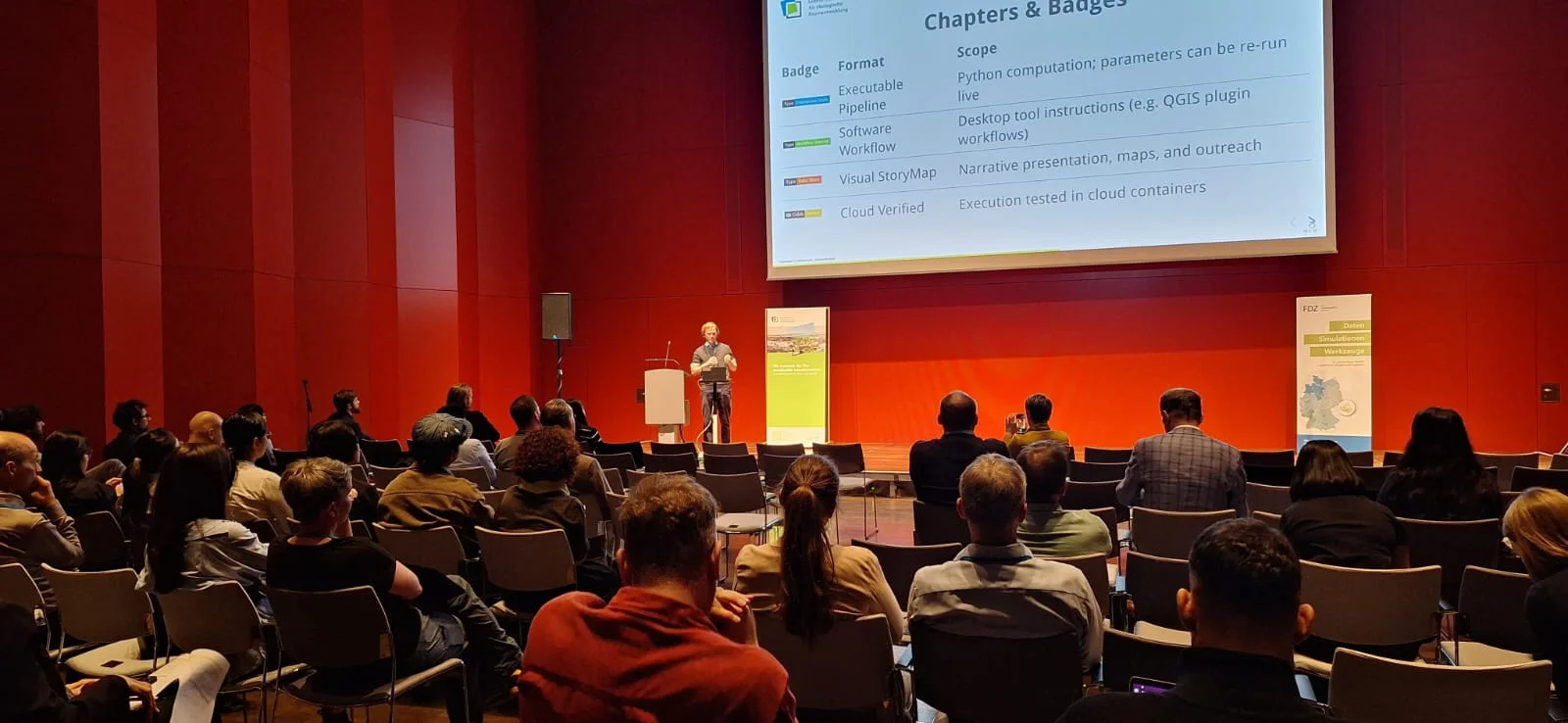 Presenting the HaCLAthon in the Großer Saal. Photo: Caspar Kleiner.
Drowning in Data and Dependencies, Starving for Synthesis
In my opening talk I tried to connect several recurring threads from the conference: trust, traceability, and epistemic fatigue (the mental exhaustion that comes from having to constantly resolve discrepancies). Science has always progressed by incremental improvement. And by standing on the shoulders of giants. But, in modern spatial data science, we often drown beneath software dependencies and data silos. Getting to the “status quo” to test a single hypothesis has become so cumbersome that momentum frequently stalls before actual discovery begins.
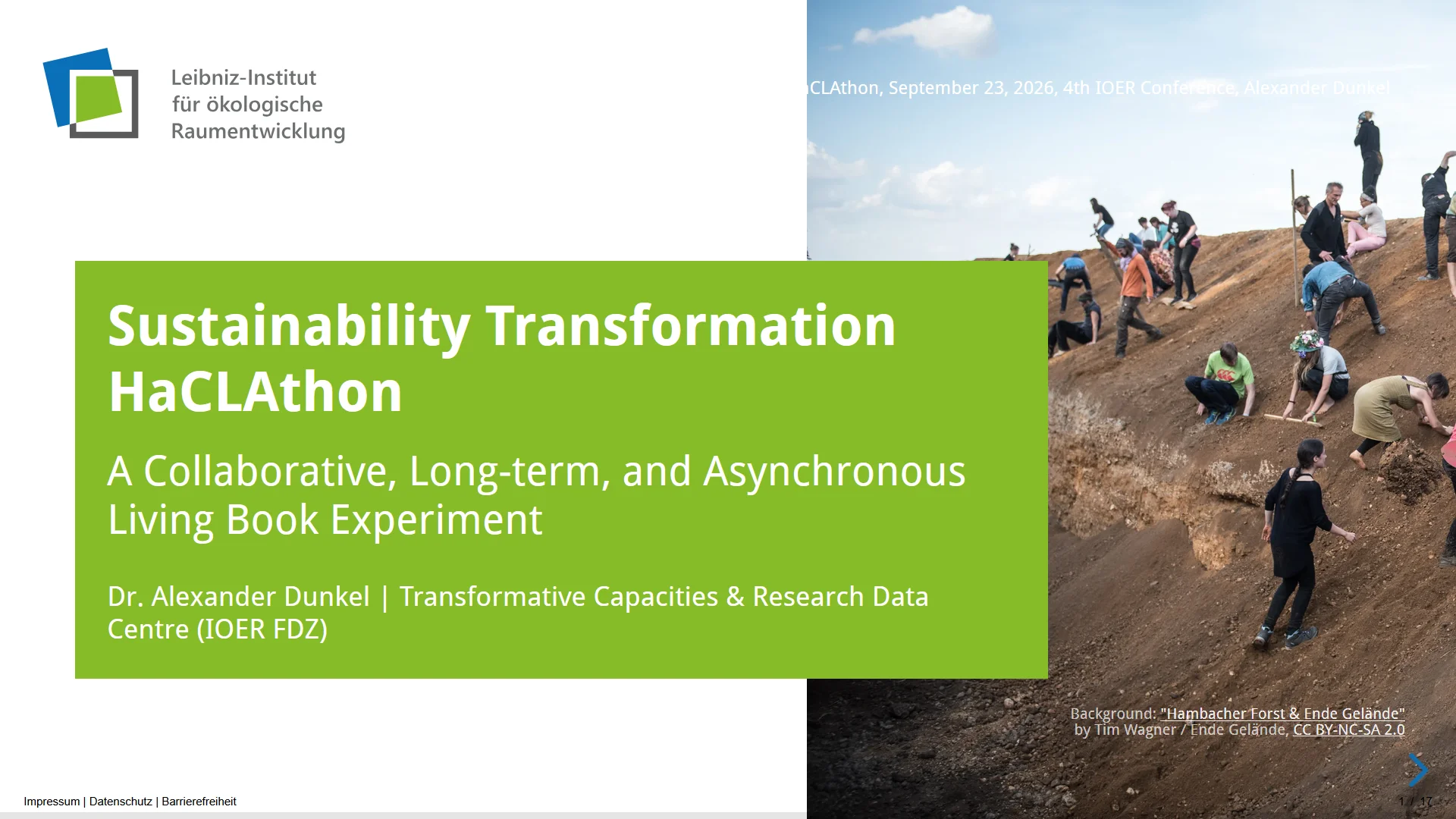 Slides: https://slides.ad.ioer.info/haclathon-presentation/
Traditional conference proceedings channel findings into static, unexecutable paper PDFs. I communicated our living Jupyter Book not as a developer novelty, but as a methodological necessity. Ou core ontribution was to make this more accessible to a broader audience: Helping non-technical people through various contribution channels and providing several parallel accessibility options, like Jupyter4NFDI, or Google Colab.
Using Git as an instrument of synthesis, the HaCLAthon documented the entire knowledge production process from day one:
- 324 commits and 60 continuous releases (v0.1.0 to v0.24.0) deployed via automated CI/CD.
- 9 contributors spanning six distinct chapters, ranging from 3D building stock metrics and local climate regulation to privacy-safe landscape attention and GTFS transit frequency.
- A lean repository footprint of 99 MB, compiling over 2.1 GB of tested cloud artifacts.
Taking the time to explain these mechanics slowly and deliberately resonated well with the audience (though it left us with a tight 10-minute window for the contributors).
Contributors in the Spotlight
Hearing the authors present their live chapters directly from the deployed book was the highlight of the session:
- Oliver Harig introduced his automated inner-zone delineation workflow (§ 34 BauGB) with the open-source QGIS IBTool plugin, demonstrating how desktop GIS tutorials can live seamlessly alongside Python notebooks.
- Gongmingyue Tang walked the audience through her interactive Heron StoryMap. Her integration of GBIF biodiversity records, canopy height data, and scrollytelling (and following code conventions!) is a showcase of how spatial data storytelling can be turned into a component blueprint with the help of Jupyter, to be reused and transferred easily to other contexts.
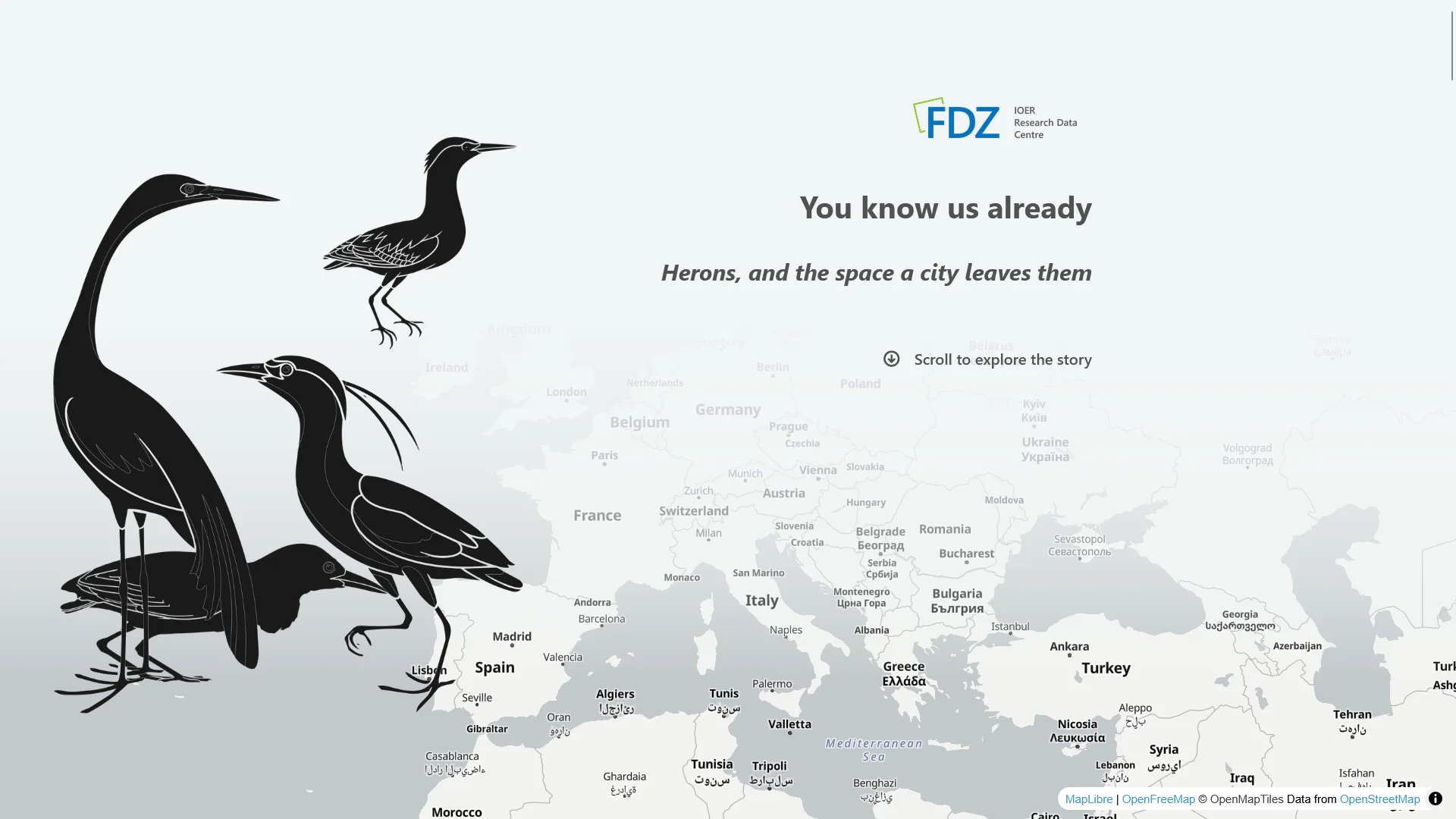 The final output: The Heron Storymap. It is a standalone HTML file, but fully reproducible (and produced) using the code shared in the corresponding chapter.
We handed out certificates of participation to recognize their courage to experiment with us in public.
What next?
After the session, colleagues asked whether we plan to repeat the format. Not 1:1. The “human compiler” role required considerable behind-the-scenes facilitation.
However, the experience provided a future development direction. Just as we built Carto-Lab Docker to guarantee containerized spatial reproducibility, we can now focus on developing reusable components that lower the barrier for spatial communication. Tango’s modular StoryMap template is a great example of an asset that future projects can adapt out of the box.
We are now entering the final polish phase. In October, we will test execution suites across Jupyter4NFDI and Colab, finalize formal CRediT statements, and freeze the repository into an immutable archive bundle with a permanent DOI (v1.0.0).